
- Model, not copy-paste. UGC positions these as guiding documents to spur flexible, innovative programme design aligned to NEP 2020: not one-size-fits-all syllabi.
- Nine disciplines in scope for this round (see above). UGC has explicitly called for feedback from HEIs and faculty before finalization.
- Deadline to engage. UGC’s public posts and notices indicate an open feedback window up to ~20 September 2025 (share inputs department-wise and via IQAC).
- DSCs carry your non-negotiable disciplinary spine.
- DSEs showcase advanced depth or emerging sub-fields.
- GEs build breadth, interdisciplinarity, and campus-wide literacy (data, environment, IKS, entrepreneurship, etc.).
- Curriculum placement: Use IKS in DSCs where historically grounded theory is essential (e.g., proofs, ratios, measurement systems), and in GEs for campus-wide cultural literacy.
- Assessment alignment: Evaluate with applications and primary-source analysis, not only recall.
- Scholarly apparatus: Cite reputable sources and critical commentary, ensuring academic rigor.
- Write POs and COs with Bloom’s verbs (Apply, Analyze, Design) and performance criteria (accuracy, complexity, autonomy).
- Map CO→PO with explicit rubrics; use a 3-level attainment scale (1/2/3) with targets set by department boards.
- Close the loop: After each cycle, use attainment data to tweak COs, pedagogy, and assessments.
- Constructive alignment: Every assessment task (projects, labs, studios, fieldwork, OSCEs in PE/Health, policy briefs in Pol. Sci., data labs in Economics, ethnographic mini-studies in Anthropology) must point back to a specific CO.
- Rubrics > marksheets: Publish rubrics in the syllabus. Include thresholds (Below/Meets/Exceeds) to compute attainment cleanly.
- Capstones & internships: Use DSEs/GE or SLC/SEC slots to host capstone research, community immersion, or industry projects consistent with LOCF flexibility.
- Anthropology: Methods-heavy design—fieldwork ethics, qualitative/quantitative techniques, and India-specific ethnographies.
- Chemistry: Safety-first labs, instrument literacy, green chemistry, data integrity.
- Commerce: Analytics for finance/marketing, governance & ethics, MSME/Startup case lets.
- Economics: Data analysis pipelines (R/Python), econometrics for policy, public finance labs.
- Geography: GIS/remote sensing studios, environmental modelling, disaster risk labs.
- Home Science: Nutrition labs, textiles/apparel design, community extension projects.
- Mathematics: Proofs + modelling, IKS strands (historical methods) with modern applications.
- Physical Education: Skill labs, sports science basics, injury prevention and analytics; align with LOCF-type structures already in use nationally.
- Political Science: Policy analysis studios, constitutional literacy, comparative politics with India-centric cases.
- Flexibility & innovation in programme design—multiple pathways, interdisciplinary choices.
- Cultural rootedness via IKS with academic rigour.
- Transparency in mapping outcomes to courses and assessments (clean matrices).
- Stakeholder feedback before rollout—students, alumni, industry, and faculty.
- Constitute a task force (IQAC lead + BoS + external expert).
- Gap-map your current syllabi against draft LOCF headings per discipline.
- Freeze POs (8–10, campus-wide alignment).
- Rewrite COs for each course with Bloom’s verbs + criteria; tag IKS elements where natural.
- Build CO-PO matrices and rubrics; set attainment targets (≥60% Meets).
- Repack courses into DSC/DSE/GE with rationales.
- Design assessments (projects, labs, OSCEs, policy memos, studios) aligned to COs.
- Insert experiential credits (internships, community projects, field schools).
- Publish model handouts (COs, rubrics, readings, weekly plan, academic integrity note).
- Submit structured feedback to UGC by the window; retain the same dossier for your Academic Council.
- Three one-pagers/course: (i) COs + weekly plan, (ii) CO-PO matrix, (iii) assessment map + rubric exemplars.
- Attainment dashboard: Dept-level sheet computing CO and PO attainment each semester; archive “actions taken.”
- IKS evidence file: Reading lists, primary texts, assignments, and assessment exemplars where IKS is used.
- Stakeholder minutes: Proof of alumni/industry input before adoption (feeds SSR/DVV later).
- Avoid token IKS. Tie traditional concepts to explicit COs and assessments.
- Don’t over-standardise. Model ≠ mandate—preserve your regional strengths and institutional mission.
- Keep evidence. Whatever you align or revise, document why and how and keep pre/post versions.


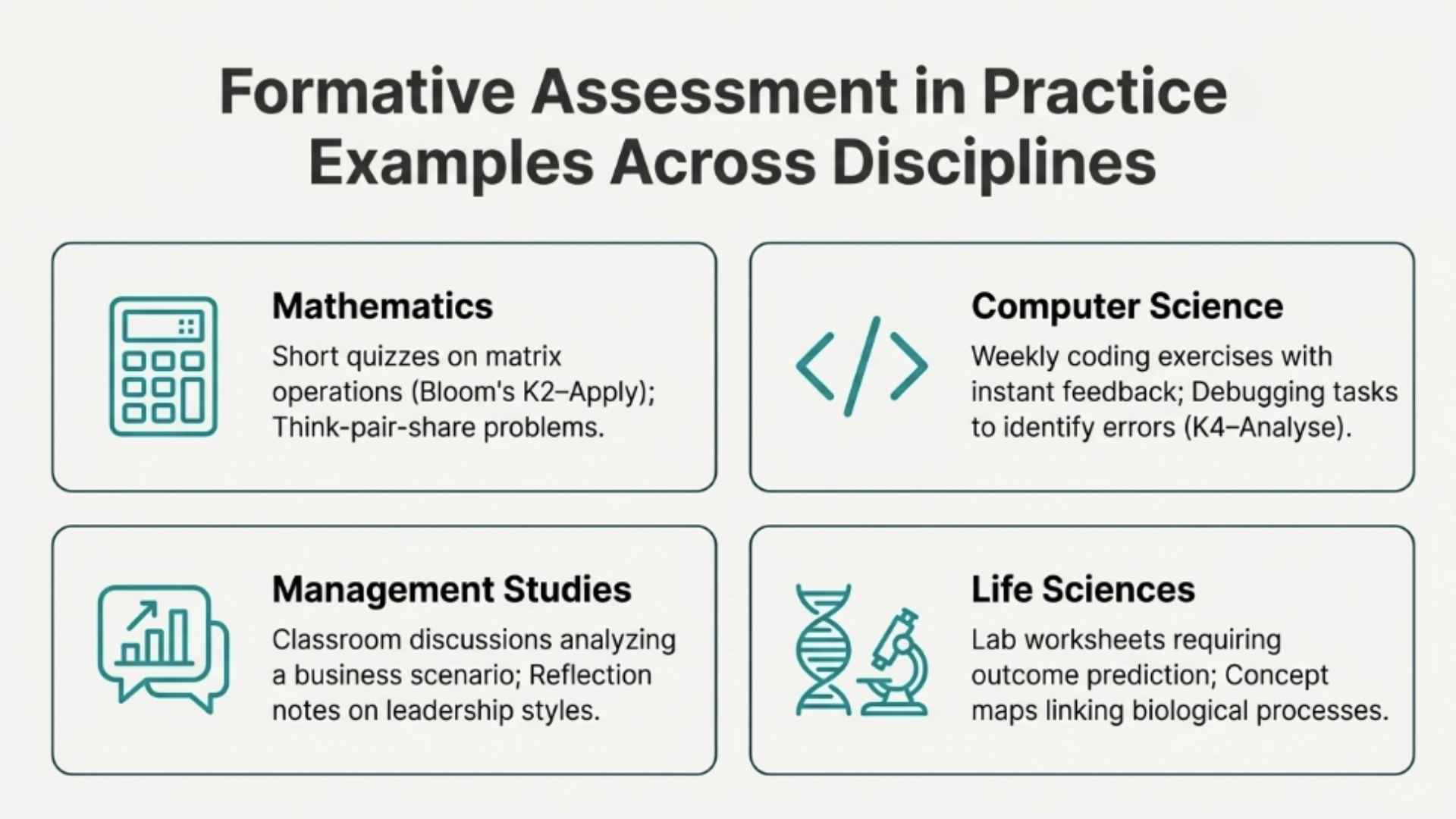 Mathematics
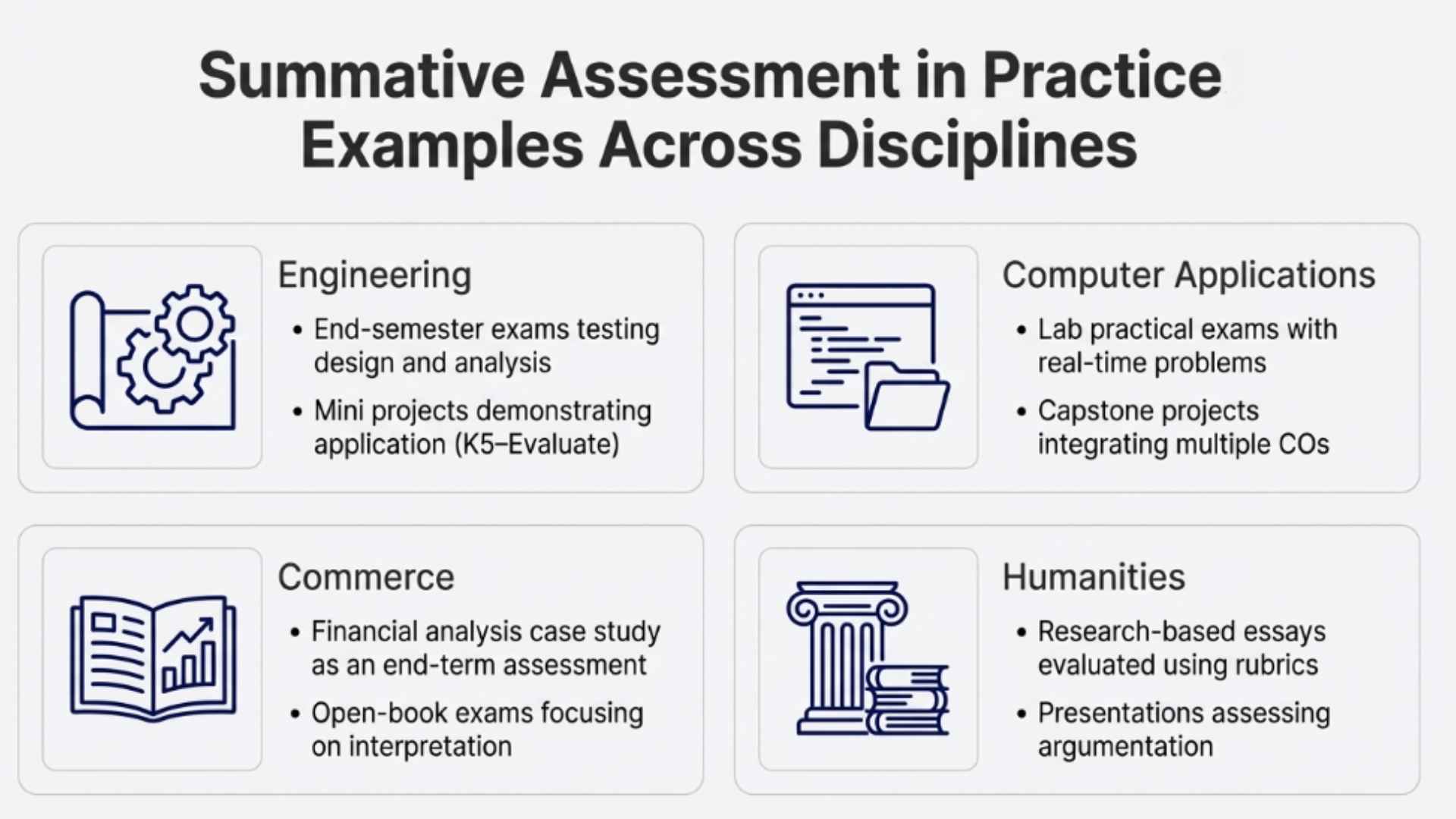 Engineering
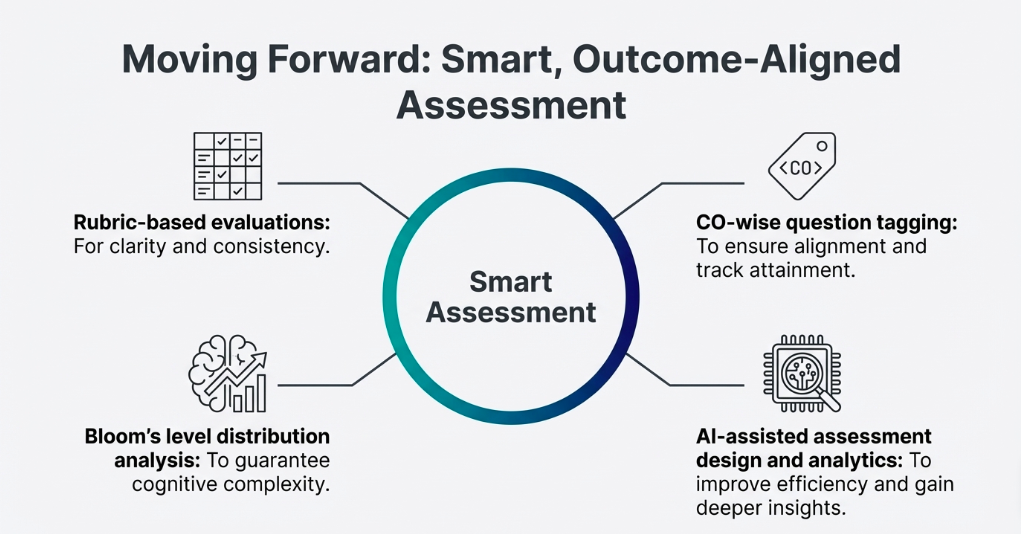 Yet, the philosophy remains traditional and timeless: Teach with care. Assess with clarity. Improve with evidence. When formative and summative assessments work together, education shifts from marks-driven to meaning-driven. And that’s where real outcomes happen. Author’s Note This article is grounded in practical OBE implementation experience across higher education institutions, aligned with accreditation frameworks and contemporary assessment research, while respecting long-standing pedagogical principles. [/fusion_text][/fusion_builder_column][/fusion_builder_row][/fusion_builder_container]