
Assessment has always been at the heart of education. Long before Outcome-Based Education (OBE) became a formal framework, teachers intuitively checked understanding during lessons and evaluated learning at the end of courses. OBE doesn’t discard this tradition—it refines it, aligns it, and makes it purposeful. At the core of OBE lie Formative and Summative assessments. Understanding their distinct roles - and using them intentionally - is what separates compliance-driven education from meaningful learning.
Assessment in OBE: More Than Just Marks
In OBE, assessment is not about how much content was covered, but how well outcomes were attained. Each assessment must answer a simple question: What evidence do we have that the learner achieved the intended Course Outcomes (COs)? That evidence comes from two complementary assessment types.
Formative Assessment: Learning in Motion
Formative assessment is assessment for learning. It happens during the teaching–learning process and provides continuous feedback to both learners and instructors.
Key Characteristics
- Conducted regularly
- Low-stakes or no-stakes
- Diagnostic and corrective
- Strongly aligned with COs and Bloom’s levels
- Focused on improvement, not judgement
Why It Matters in OBE
Formative assessments ensure that students are on track to achieve outcomes before it’s too late. They help faculty:
- Identify learning gaps early
- Modify teaching strategies
- Support diverse learners
- Build higher-order thinking gradually
Subject-wise Examples
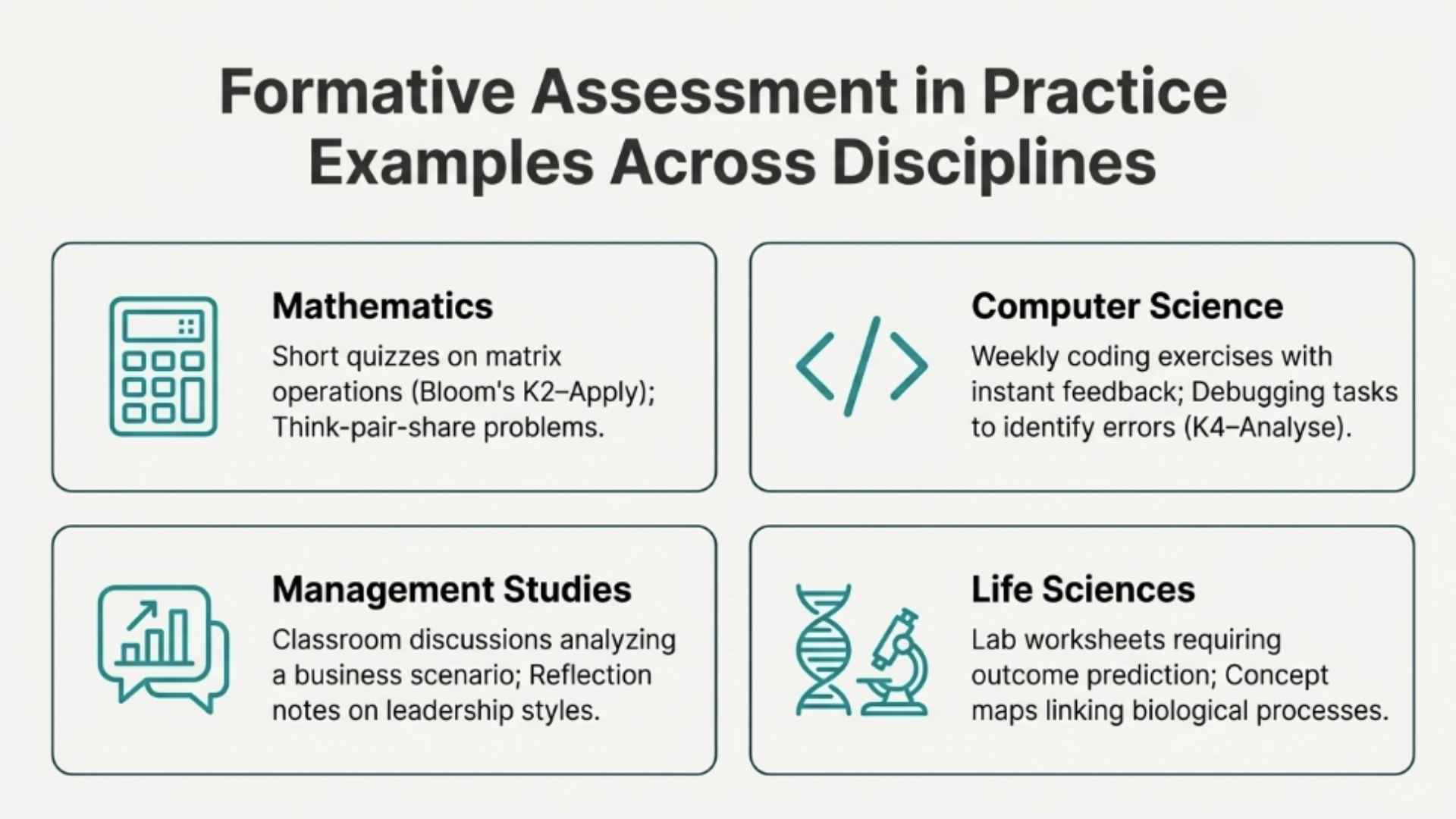 Mathematics
- Short quizzes on matrix operations to check procedural understanding (Bloom’s K2–Apply)
- Think-pair-share problems during lectures to test conceptual clarity
Computer Science
- Weekly coding exercises on loops or recursion with instant feedback
- Debugging tasks where students identify errors in given code (K4–Analyse)
Management Studies
- Classroom discussions analysing a short business scenario
- Reflection notes on leadership styles after a case discussion
Life Sciences
- Lab worksheets requiring students to predict outcomes before experiments
- Concept maps linking biological processes
Formative assessments create a safe space to fail, reflect, and fix. That’s real learning energy. From Principle to Practice Formative assessment becomes truly powerful when students experience learning as an active process rather than a series of checkpoints. Experiential designs, when aligned with course outcomes, create space for inquiry, mistakes, and conceptual clarity. For example, one way experiential formative assessment can be intentionally designed is illustrated through this linked article, GraphQuest: Exploring the Logic of Links. Structured as an outcome-aligned formative bootcamp, GraphQuest shows how experiential learning can be designed to meet OBE expectations with clear CO and Bloom’s level alignment.
Summative Assessment: Evidence of Achievement
Summative assessment is assessment of learning. It is conducted after sufficient learning has taken place and is used to certify achievement of outcomes.
Key Characteristics
- High-stakes
- Conducted at the end of a unit/course/semester
- Structured and standardized
- Used for grading, progression, and certification
- Strong CO–PO mapping relevance
Why It Matters in OBE
Summative assessments provide documented, auditable evidence of outcome attainment—critical for:
- Academic credibility
- Transparency
- Accreditation (NAAC, NBA, NIRF)
- Institutional accountability
Subject-wise Examples
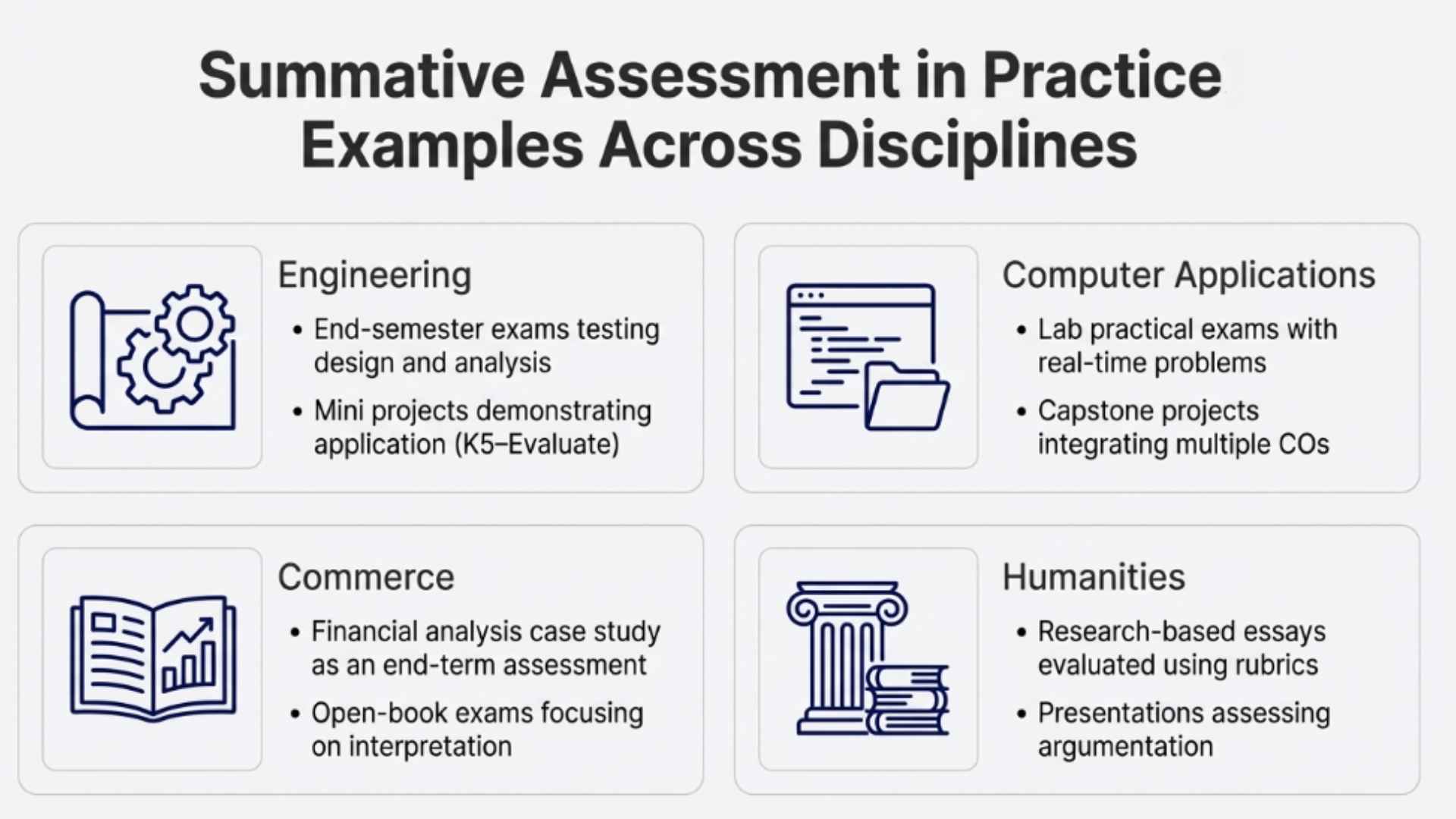 Engineering
- End-semester exams testing design, analysis, and problem-solving
- Mini projects demonstrating application of core concepts (K5–Evaluate)
Computer Applications
- Lab practical exams with real-time problem statements
- Capstone projects integrating multiple COs and POs
Commerce
- Financial analysis case study as an end-term assessment
- Open-book exams focusing on interpretation rather than memory
Humanities
- Research-based essays evaluated using rubrics
- Presentations assessing argumentation and critical thinking
Summative assessments answer the big question: Did the learner finally achieve what we promised?
Formative vs Summative: Not Either–Or, But Both
| Aspect | Formative | Summative |
| Purpose | Improve learning | Measure achievement |
| Timing | During learning | End of learning |
| Stakes | Low | High |
| Feedback | Immediate, descriptive | Final, evaluative |
| OBE Role | Supports attainment | Confirms attainment |
In strong OBE practice, formative feeds summative. When formative assessments are well-designed, summative success becomes natural—not stressful.
Common Mistakes Institutions Make
- Treating internal assessments only as mark-generation tools
- Overloading summative exams with memory-based questions
- Weak alignment between COs, Bloom’s levels, and assessment tasks
- Ignoring formative data during attainment analysis
OBE expects intentional design, not mechanical compliance.
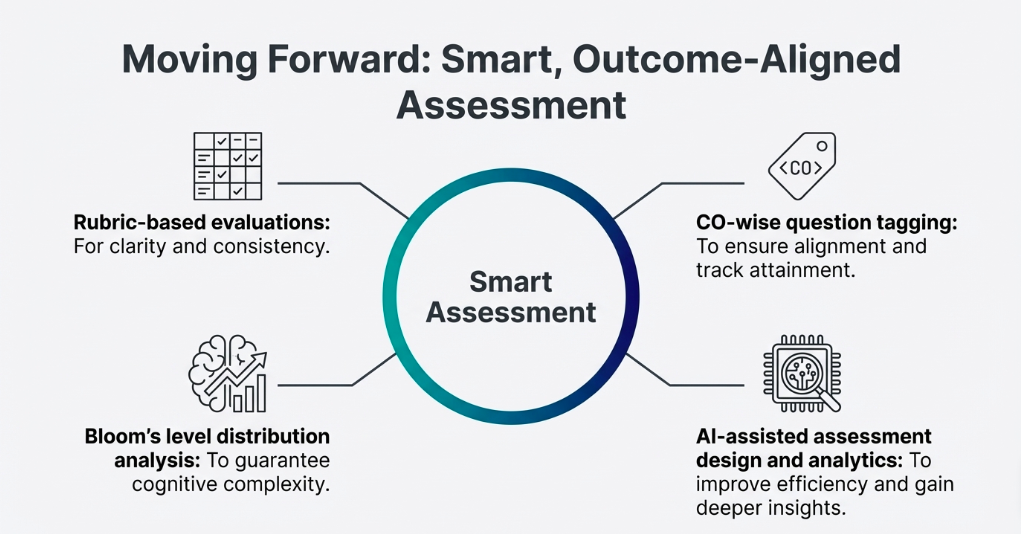
Moving Forward: Smart, Outcome-Aligned Assessment
Modern institutions are now leveraging:
- Rubric-based evaluations
- CO-wise question tagging
- Bloom’s level distribution
- AI-assisted assessment design and analytics
 Yet, the philosophy remains traditional and timeless: Teach with care. Assess with clarity. Improve with evidence. When formative and summative assessments work together, education shifts from marks-driven to meaning-driven. And that’s where real outcomes happen. Author’s Note This article is grounded in practical OBE implementation experience across higher education institutions, aligned with accreditation frameworks and contemporary assessment research, while respecting long-standing pedagogical principles. [/fusion_text][/fusion_builder_column][/fusion_builder_row][/fusion_builder_container]

