
Structure of Rubrics
A rubric is an evaluation manual used for scoring the students’ response, based on the expectation of quality around a task. A rubric includes three components:- the criteria to which evaluation to be made
- the scale of assessment of the criteria
- the qualitative statements corresponding to each criterion (descriptors).
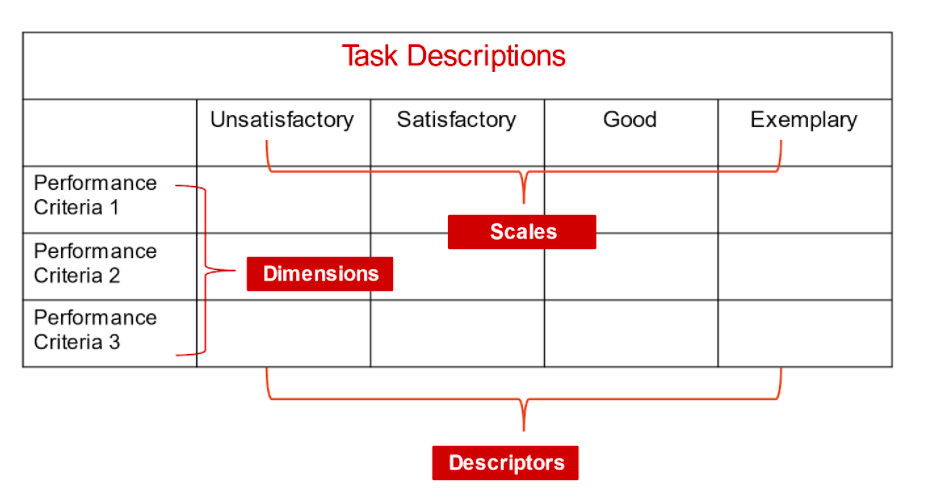 Here, a rubric will help to identify how well the students have met the criteria corresponding to the learning outcome than their respective position with respect to their peers. Thus, for an objective estimation of student’s performance using assessments tools like assignments, projects, seminars, portfolios, exams etc. it would be ideal to prepare evaluation Rubrics, based on the criteria that are significant.
Types of Rubrics
Based on the type of scales adopted in the rubrics we could classify the rubrics as Checklist, Holistic rubrics and Analytic Rubrics. If we adopt a dichotomous scale like “yes or no”, “criteria met or not met” we call it as a Check List. This type of rubrics is easy to use and it will only ensure the presence of the trait or criteria. It does not give any information about the level of performance related to the criteria. In both holistic rubrics and analytic rubrics, Likert rating scale is used to mark the level of performance of the students. The holistic rubrics is modelled in such a way that it does not differentiate the various criteria of performance, instead assigns a single score based on an overall assessment of the students work. Analytic rubric digs deep into criteria-level to project the criteria wise judgement of the student’s work. However, the score assigned to each level of performance is an ordinal scale of measurement.Preparation of Rubrics
Preparation of an evaluation rubrics creates clarity of focus on the assessment process and outcomes among the assessors. This will directly influence the teachers in generating the right environment for learning appropriate for the learning outcomes. It is also a good practice to share the rubrics to the students so that they remain focused on their learning process. The development of rubrics requires a deep insight into the curricular structure and the nature of activity or tools for which rubrics are developed. The sequential steps in the construction of a rubrics are detailed here. The first stage is the review of the learning outcomes by breaking down the outcomes into component outcomes and connect it to the activities or tools for which the evaluation rubrics are developed. The next stage is to identify the set of criteria related to the activity that addresses the component outcome under consideration. The third stage is to develop quality statements for each criterion. These statements should be specific, observable and measurable descriptors which characteristics the expectation at each level of performance. The fourth stage is to arrange the criteria and scale of measurement with the appropriate qualifying statement in a tabular grid. The fifth stage will be to assign a numerical score to each level of performance. The next phase is to ensure the fairness of the rubrics with expert opinion from resource persons and by using it to evaluate the previous students’ performance. It is also a good practice to share the rubrics to the students before they involve in the assigned activity that will be assessed.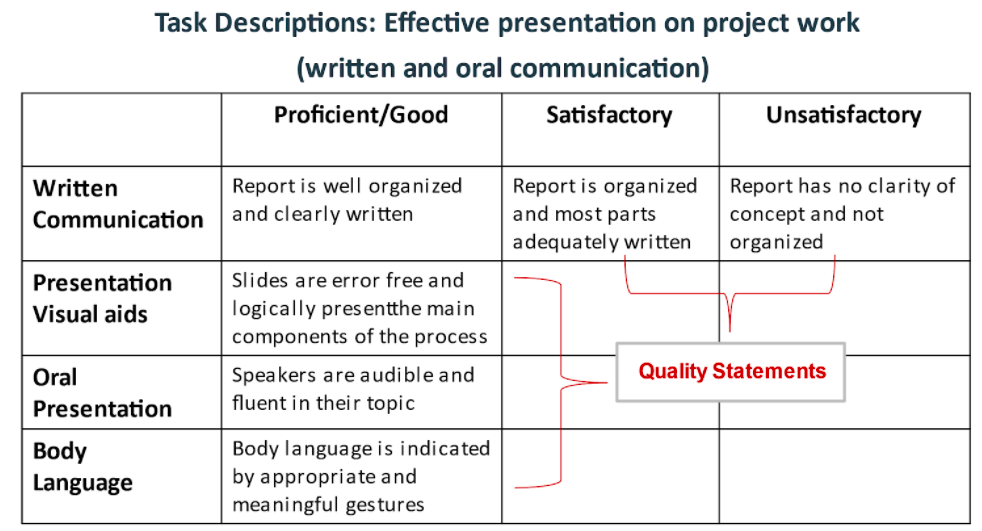 In an OBE enabled evaluation plan, the evaluation rubrics must be integrated with the outcomes – at both course level and the program level with which the activities correlate. For this, each criterion must be mapped onto the corresponding outcomes that each criterion addresses. Also, the mapping strength should be recorded in terms of high, moderate or low. This should be mentioned in a score pattern which ranges from 3 to 1. It should be presented as a matrix extension grid of various criteria to outcomes at the course level and program level as shown in the figure.
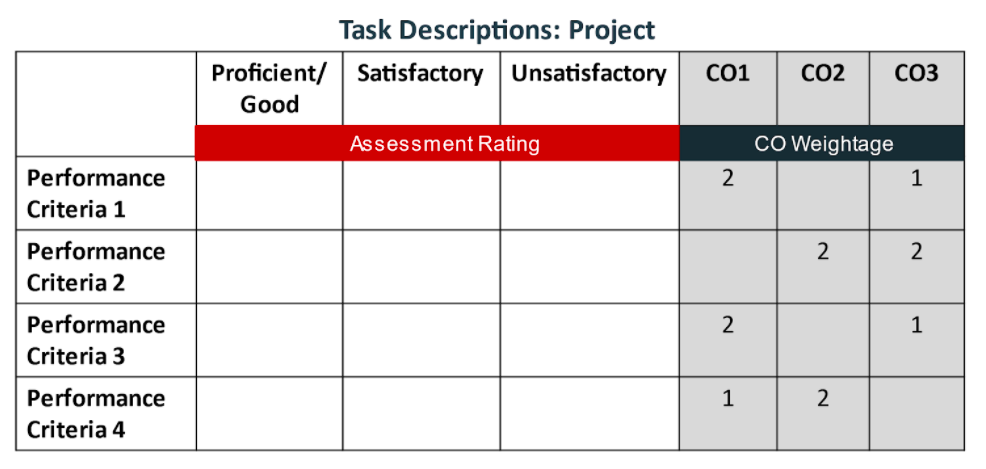 The weighted average of the attainment scores converted into a three-point scale will contribute to the score of outcome attainment with respect to the activity. These attainments could be cumulated to the Program matrix table or the course matrix table for computation of the respective course outcome or program outcome.
Development of an appropriate analytic rubrics is a skill which needs a certain level of expertise. However, there are few customizable templates available online, for easier creation of rubrics. Beginners who are not familiar with rubrics-making can work with such templates to enhance the competency level so that in further stages they could build better rubrics independently as per the requirements.
The weighted average of the attainment scores converted into a three-point scale will contribute to the score of outcome attainment with respect to the activity. These attainments could be cumulated to the Program matrix table or the course matrix table for computation of the respective course outcome or program outcome.
Development of an appropriate analytic rubrics is a skill which needs a certain level of expertise. However, there are few customizable templates available online, for easier creation of rubrics. Beginners who are not familiar with rubrics-making can work with such templates to enhance the competency level so that in further stages they could build better rubrics independently as per the requirements.


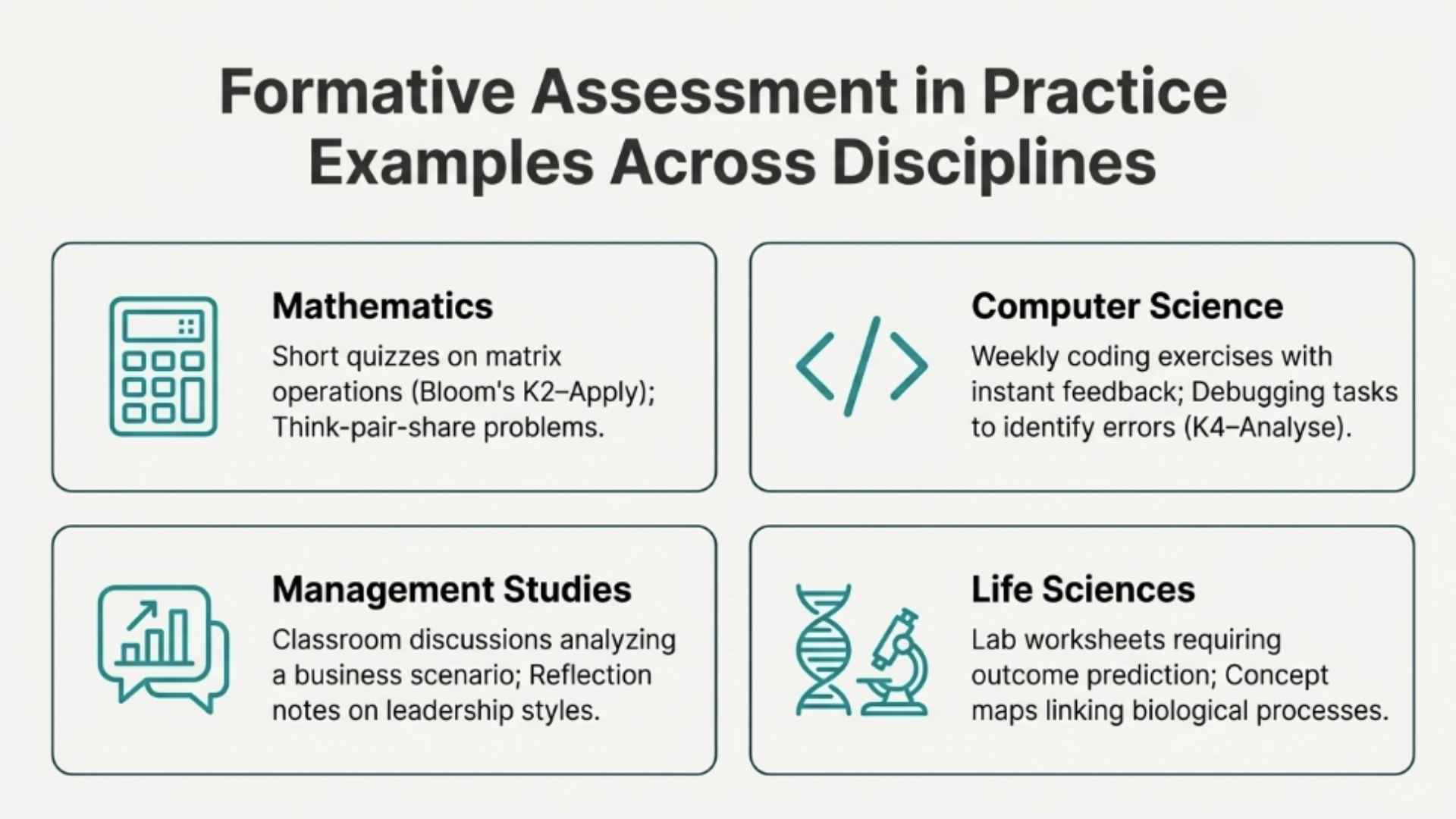 Mathematics
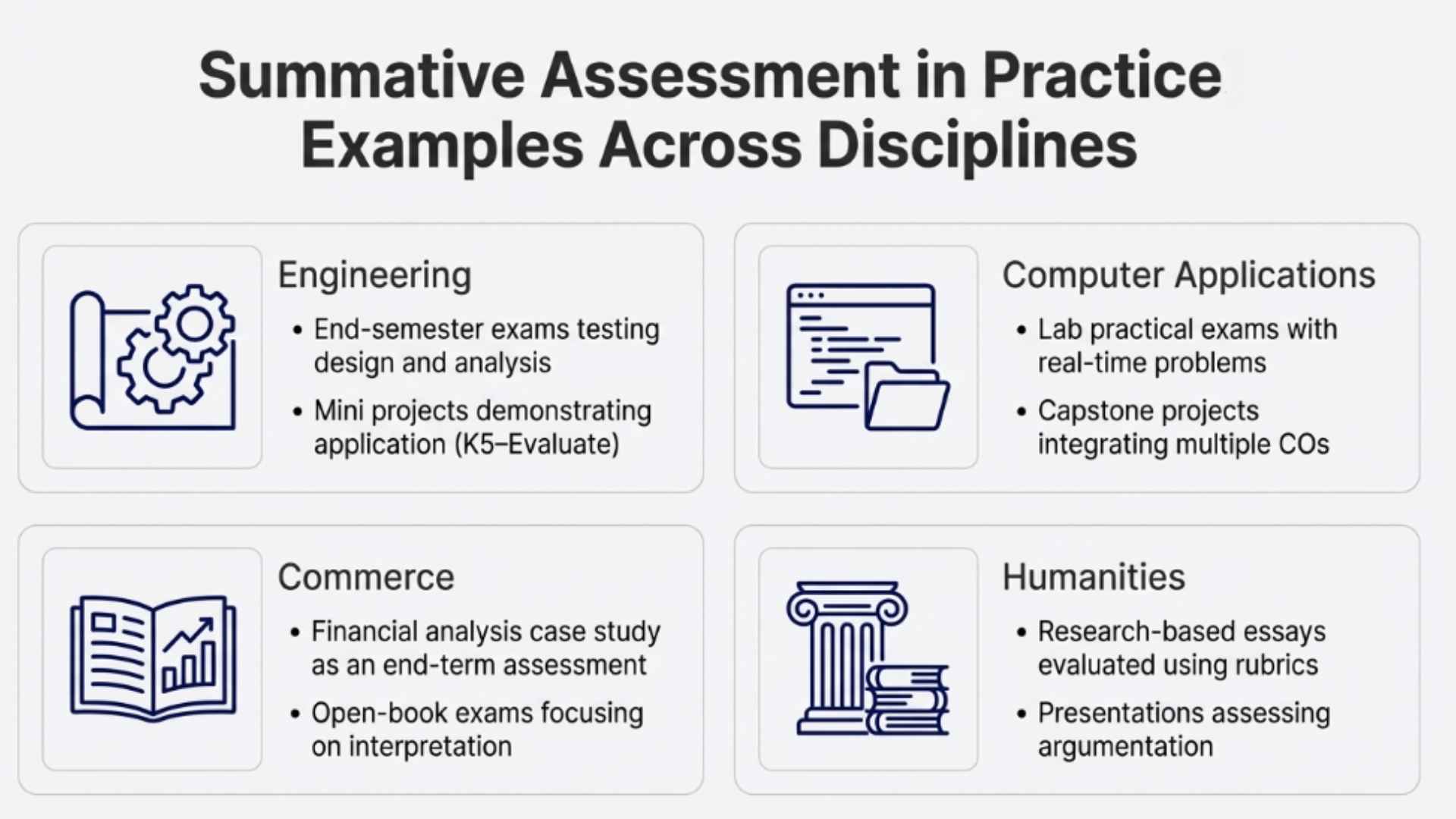 Engineering
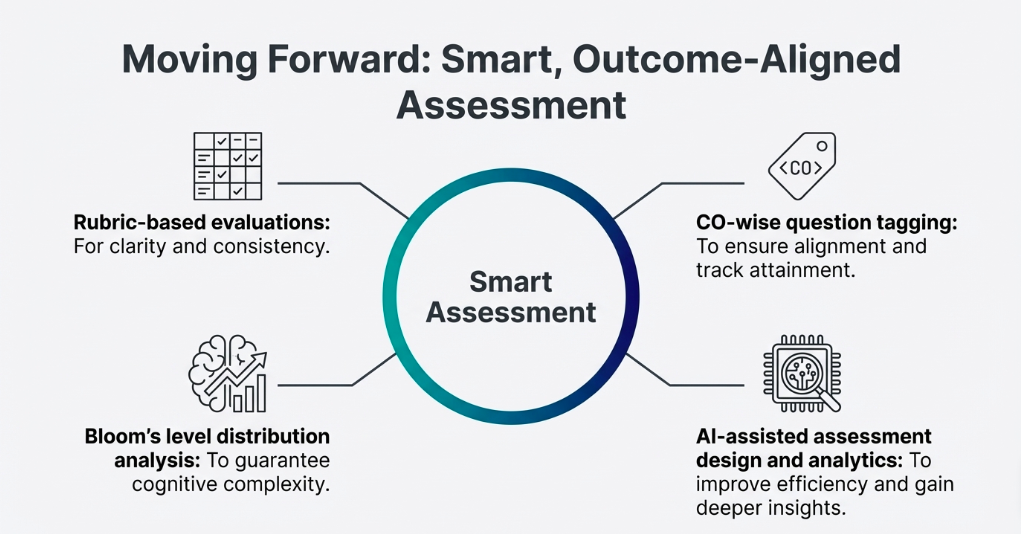 Yet, the philosophy remains traditional and timeless: Teach with care. Assess with clarity. Improve with evidence. When formative and summative assessments work together, education shifts from marks-driven to meaning-driven. And that’s where real outcomes happen. Author’s Note This article is grounded in practical OBE implementation experience across higher education institutions, aligned with accreditation frameworks and contemporary assessment research, while respecting long-standing pedagogical principles. [/fusion_text][/fusion_builder_column][/fusion_builder_row][/fusion_builder_container]