
Outcome-based education is a model of education that deviates from the traditional focus on what the institution provides to students, in favour of making students demonstrate that they "know and are able to do" on completion of course or program. Consequently, this approach signifies a shift in the paradigm of the system of education from teaching to learning.
This article outlines a model for preparing an OBE manual for a Higher Education Institution, which would lay down the blueprint for implementation of Outcome Based Education in the College or HEI. Positively, a few best practices and guidelines in the implementation of OBE are also depicted in this article.
A good manual on OBE should underpin the theoretical concept behind OBE, the rationale behind the OBE approach, guidelines for implementation of OBE, details for academic staff about the procedures that assist them in sustainable and continuous improvement of the teaching-learning process and detailed design for the Outcome Based Assessment. Hence an OBE manual should provide a detailed guideline on the entire process related to the implementation of OBE.
The various sections that could be included in the preparation of an OBE manual are discussed in this article.
The Cover Page and the Preface: Just like any formal documents, a good covering page and preface pages with relevant information are required.
The preface of an OBE manual should include the following details
- Institutional Name and branding
- A Suitable Title - Eg. Manual – Implementation of Outcome Based Education (OBE)
- A suitable Caption.
- Year and Edition No.
- Details of the Editorial Board or the OBE Implementation Committee.
Table of Content
A ToC is also an essential part of a good formal document. The following is a sample ToC, but this article will be elaborated based on the same. HEIs are expected to modify the ToC and further contents based on their OBE implementation strategy.
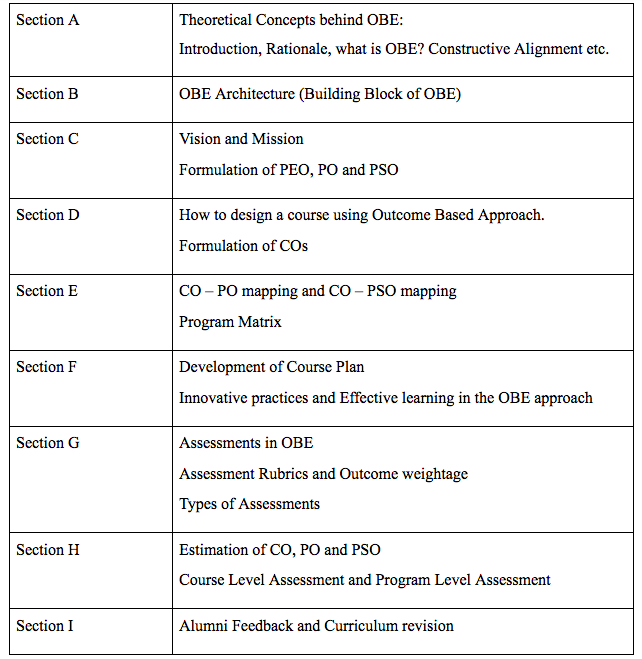
[/fusion_text][fusion_table_of_contents allowed_heading_tags="h2,h3,h4" limit_container="post_content" hide_hidden_titles="yes" highlight_current_heading="no" enable_cache="yes" hide_on_mobile="small-visibility,medium-visibility,large-visibility" counter_type="upper-roman" icon="fa-flag fas" counter_separator="dot" item_text_overflow="no" animation_direction="left" animation_speed="0.3" animation_delay="0" /][fusion_text]
Section A: Theoretical Concepts behind OBE
The Introductory section of the OBE manual should depict the concept and significance of the OBE. It will be better if we could include the following points with a brief detailing at this session- Introduction
- The rationale being OBE
- What is Outcome Based Education
- Traditional Vs Outcome Based Education
- Factors affecting the success of OBE
Section B: OBE Architecture
This session should give a clear and vivid representation of the OBE topology. The visual depiction of the building blocks of OBE will be more meaningful in this section. The hierarchy of the various components and how its related to each other should be detailed. The process flow of activities at the formulation stage of OBE and the process pipeline at the assessment stage should be detailed here.Section C: Vision and Mission, Formulation of PEO, PO and PSO
The vision and mission of the college should be presented in this session. Mission being the action statement pointing to the Vision it is a good practice to present the Mission as separate statements. These statements should be unique and should not vary while presenting the same in other documentation. Program Educational Objectives (PEO): The broad statements that focus on what the students are expected to attain within the first few years (5 years) after completion of the program should be presented here. Program Outcome (PO): These refer to the knowledge, skills and attitudes (Graduates Attributes) that the students should have at the end of the program. The PO’s are formulated on the basis of the PEOs and the Vision and Mission of the Institution. Normally an institution could maintain a unique set of PO’s (general attributes) for the entire programs of the Institution. The optimum number of POs shall range from 7 to 12. These outcome statements should be listed here. Program Specific Outcomes (PSO): These refers to what the graduates of a specific program will be able to do on completion of the program. These statements are domain-specific and depict the knowledge, attitude and skills related to the specific domain. It is a good practice to limit the number of PSOs within the range of 2 to 4. Since the number of PSOs for the entire programs of an Institutions is too large, it is not mandatory to include all the PSO statements here. Each department could keep departmental wise documentation of OBE where the respective PSOs could be documented.Section D: How to design a course using Outcome Based Approach
The particulars that could be included in this session include- Details regarding the steps in developing a course using Outcome Based Approach
- Course Outcome and Structure of a course outcome.
- Role of action verbs in formulation of course outcome
- Blooms Taxonomy and classification of educational objectives.
- Good and Bad learning outcome
Section E: CO – PO mapping and CO – PSO mapping
The final assessment in an OBE approach is the estimation of the level of attainment of POs and PSOs. These outcomes are estimated from the estimates of all COs and Activity Outcomes AOs of the entire program. Hence every Course Outcomes (COs) and other Activity Outcomes (AOs) should be mapped onto the respective POs and PSOs in terms of the strength of mapping. The mapping scale for the estimation of mapping strength and the procedure of obtaining the mapping strength may be detailed in this section. A sample copy for reference and the format for mapping may be included in this session. CO – PO / PSO mapping of every course should be documented as a departmental document along with the program matrix for each program.Section F: Development of Course Plan
A course plan is a guided plan of the components of the course. This help in providing a check of various components in terms of the course outcomes. The cardinal principle behind the OBE process is constructive alignment. The main aspects to be included in a good course plan include- Course Outcomes.
- Kind of teaching, learning, strategies and support system included in the course
- Performance indicators and Assessment strategies
- Flow chart of curricular Progression
- Constructive Alignment
- Innovative practices and Effective learning.
Section G: Assessments in OBE
Outcome Based Assessment is another major component in an OBE manual. Details regarding various types of assessments and the procedures for ensuring objectivity, validity and reliability in the assessment process should be detailed in this section. Few concepts that could be included here are- Formative and Summative Assessments
- Direct and Indirect Assessment
- Design of a rubrics
- Integration of rubrics with Outcomes
- Integration of question paper with Outcomes
Section H: Estimation of CO, PO and PSO
This section should include- Estimation of COs:
- Estimation of POs and PSOs:
- Course Level Assessment:
- Program Course Level Assessment:
