Advantages of AAA
The advantages of an academic audit are manifold such as, but not limited: For students: It helps in eliminating unnecessary workload and dwells mainly on those essentially required for the success of a student’s career. For teachers: It helps in clarifying their roles and responsibilities and thus avoids conflicts. For employers: It ensures availability of well-rounded students who can contribute from day one itself. For the Administrators: It gives an insight into the overall quality of the institution including its strengths, weaknesses, opportunities and threats. For Management: It ensures the proper use and effectiveness of the processes, systems, infrastructure, practices, infrastructure, HR and facilities in the practice of the institution and to implement corrective measures.Principles of the Academic Audit
Based on the NAAC criteria, the AAA team draws attention to the following points: Focus on teaching-learning and evaluation process:- how teachers teach (both conventional and innovative), how students learn (both formal and informal), and how best the students are assessed (both for life and career). Define quality in terms of learning outcomes:- PO, PSO and CO mapping; and aligned with learning objectives. Develop research culture:- a quest for new knowledge generation. Teamwork:- collective responsibility, accountability and sharing. Evidence-based Documentation:- of all programmes, activities and achievements. Continuity and consistency:- based on the vision and mission of the institution. Application of best practice:- best suited to the institution and the department. Community orientation and Public perception:- campus community interaction and connectivity. Alumni and placement:- both are brand ambassadors of an institution. Continuous improvement:- continually and consciously strive to improve for the total quality development of the students, teachers and the institution. Good Governance:- clearly defined hierarchy, administrative procedures and practices, systems, HR and other policies, transparent financial management, complaint resolution mechanism, etc. Public Perception:- the accomplishment of the needs of the various stakeholders such as students, parents, teachers, staff, statutory authorities, society and the community.Types of AAA
Generally, there are two types of AAA - Internal AAA and External AAA. NAAC has prescribed a specific methodology and guidelines for conducting Academic and Administrative Audit (AAA) in the institutions. With the approval of the authorities, the IQAC of the respective institution can evolve strategies and procedures for conducting the audit, on the basis of their requirements and in line with the seven criteria fixed by the NAAC.Internal AAA
Internal Audit shall be done by IQAC of the institutions. Every Institution is expected to conduct internal AAA at regular intervals to review the programmes and activities at the department level and the institution as a whole. The Internal Audit process might take 3-5 days to complete.Composition of Internal AAA team
The Internal Audit team usually consists of 3-5 senior teachers of the institution along with the Vice Principal and the IQAC coordinator.- Principal
- Vice-Principal(s)
- Representative from management
- IQAC Coordinator and Criteria Heads
External AAA
The external audit is to be done in the institution by external peers/ experts.Composition of External AAA team
External Audit team consist of a chairman & 2-3 peers, preferably NAAC Peer Team members or those from institutions belonging to the A+ category of NAAC evaluation. Auditors are primarily teachers who have experience and/or training on academic quality systems, processes and strategies and audit tactics and methodologies.The Process of External AAA
The External Audit needs 2-3 days to complete. The External Audit team, in the beginning, will meet and interact with the Principal and the IQAC team to collect the details of the programmes and activities being conducted/ undertaken during the period of audit. Auditors will then visit all departments and facilities and generally verify the Self Study Report along with supporting documents. They will interact with the HoD and the teacher in charge of quality assurance and will seek for doubts and clarifications if any. After conducting the audit in all the departments and facilities, the audit team will sit with the IQAC team to obtain further details, documents and clarifications. Before the exit meeting, the external audit team will again interact with the Manager, Principal and the IQAC coordinator and present the brief observations and findings of the audit. Both parties (the Principal, the IQAC Coordinator and the Audit Team) can express their views and analysis on the observations and findings of the audit. Finally, the External Audit team meets the teachers and staff and the Chairman of the Audit team will present a brief summary of the observations and findings of the audit.Stages of the AAA process
Stages of the academic and administrative audit process involve the following stages:- Preparing the “Self-study Report” with evidence-based documentation,
- Internal peer review and evaluation of the self-study report,
- Modifying the self-study report based on the internal peer
- Implementing the suggestions and rec review report
- External Peer review/ audit by the external audit team
- Implementing the suggestions and recommendations of the external peer audit
Preparation of Self-study Report
Each department shall prepare a self-study report, based on the latest seven NAAC criteria, of their respective departments. It shall include all the programmes and activities of the department with supporting documents/ evidence. Give emphasis to the following points:- The Course plan and Teaching plan along with the programme architecture and logic prepared in the Annual Academic Planning meeting is to be given with due importance
- Innovations implemented for the teaching, learning and evaluation
- Work Diary, Class Diary and Monthly Performance Report (MPR) along with its analysis of the teachers
- Strategies put into practice for the implementation of Outcome-Based Learning (OBE) and PO, PSO and CO mapping
- Remedial coaching, Mentoring and counselling, programmes and activities
- Research (including Major and Minor Research), Publication, Consultancy, Project, Tie-ups and collaboration, Joint programmes, etc.
- Seminar/ Conference/ Workshops conducted by the department as well as attended by the staff and students outside the college including paper presentation and chairing the sessions, Start-ups by students and alumni, etc
- Teacher Performance Appraisal, Feedback Analysis of teachers along with Action Taken Report, Department Growth Plan and Personal Growth Plan, Satisfaction Survey and Need-analysis of students
- Placement activities/initiatives including Soft-skills, Life-skills, Career Skills, Time Management, Image Building, Personal Grooming, etc
- Best/ exemplary Practices, Green initiatives, Waste management, Gender sensitivity, Swatch Barat, Ek Bharath Shrestha Bharath, ‘Interdepartmental competition’, ‘Interdepartmental cooperation’, Facilities for the Differently Abled, etc
- Department Icon activities and Celebration of Great Indian Personalities, Minutes of the department meetings, Staff and students welfare activities
- Institutional Extension Activities and Campus Community Initiatives, Campus Industry interactions, etc
- Alumni Association programmes, activities and interaction and the Resource mobilization through the Alumni.
- Strengths, weaknesses, Opportunities and Threats/ Challenges of the department describing initiatives to address practices that need improvement
- Future plans, and its implementation strategies and priority-wise plans for improvement
Review by Internal Teams/Peers
Once the yearly/ periodic Self-study Report with evidence-based documentation is ready, the internal audit team will review it by going to each department, administrative units and facilities. On the basis of their observations, the internal audit team will prepare a report and submit it to the Principal. The Principal after careful check and review will pass it on to the IQAC for implementation of the suggestions and recommendations.Modify the self-study report
The IQAC team will carefully study the suggestions and recommendations of the internal audit team and implement and modify the Self Study Report.Audit by the external audit team
Once the Self Study Report is modified, the external audit team will be invited to conduct the external Academic and Administrative Audits (AAA). They will prepare a schedule for the AA (model given at Annexure) and will conduct the AAA accordingly in all the departments, administrative units and facilities. On the basis of their visit and observations and discussions with the IQAC Coordinator and the Principal, the external audit team will give a report to the Principal usually in an exit meeting.Implement recommendations from the audit
The Principal after careful check and review will forward the report of the External Audit team to the IQAC for implementation of the suggestions and recommendations. A detailed plan of action may be prepared to implement the suggestions in a phased and organised manner.Conclusion
By establishing the Internal Quality Assurance Cell (IQAC) and undergoing Academic and Administrative Audits (AAA) process regularly, it is possible for all Institutions of Higher Education HEIs) to continuously strive for excellence. The assessment, monitoring and evaluation of the institutional processes require a carefully structured system, course of action and procedure of internal and external audit and reviews. The NAAC expects the Institutions to undertake continuous internal and external Academic and Administrative Audits (AAA) on a regular basis. If implemented properly and systematically it will help all Institutions of Higher Education (HEIs) to impart quality culture and perform better in all aspects of academic functioning and performance for the benefit of all its stakeholders.Annexures:
AAA - Sample Schedule
Sample document for Scheduling AAA team visit


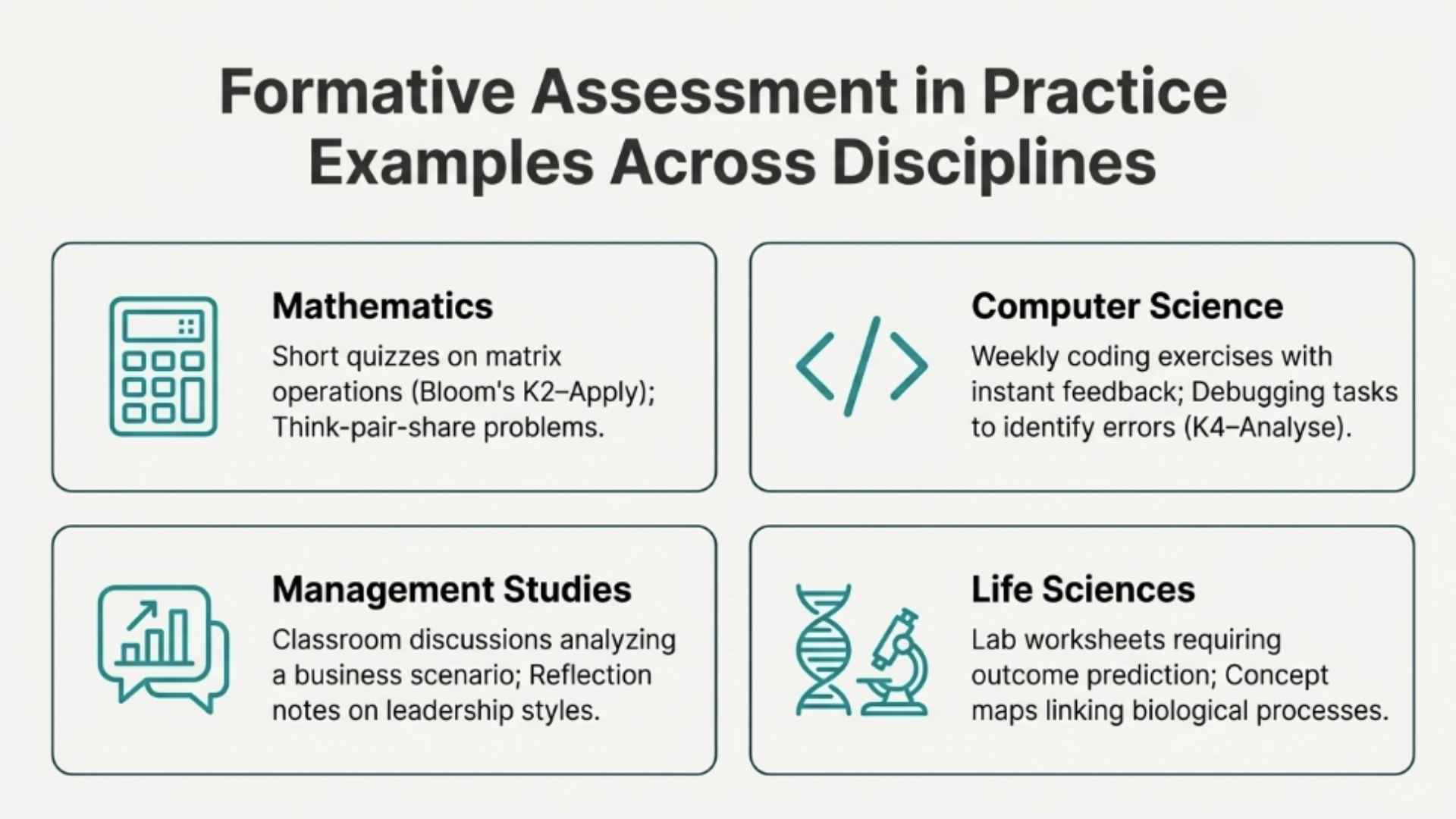 Mathematics
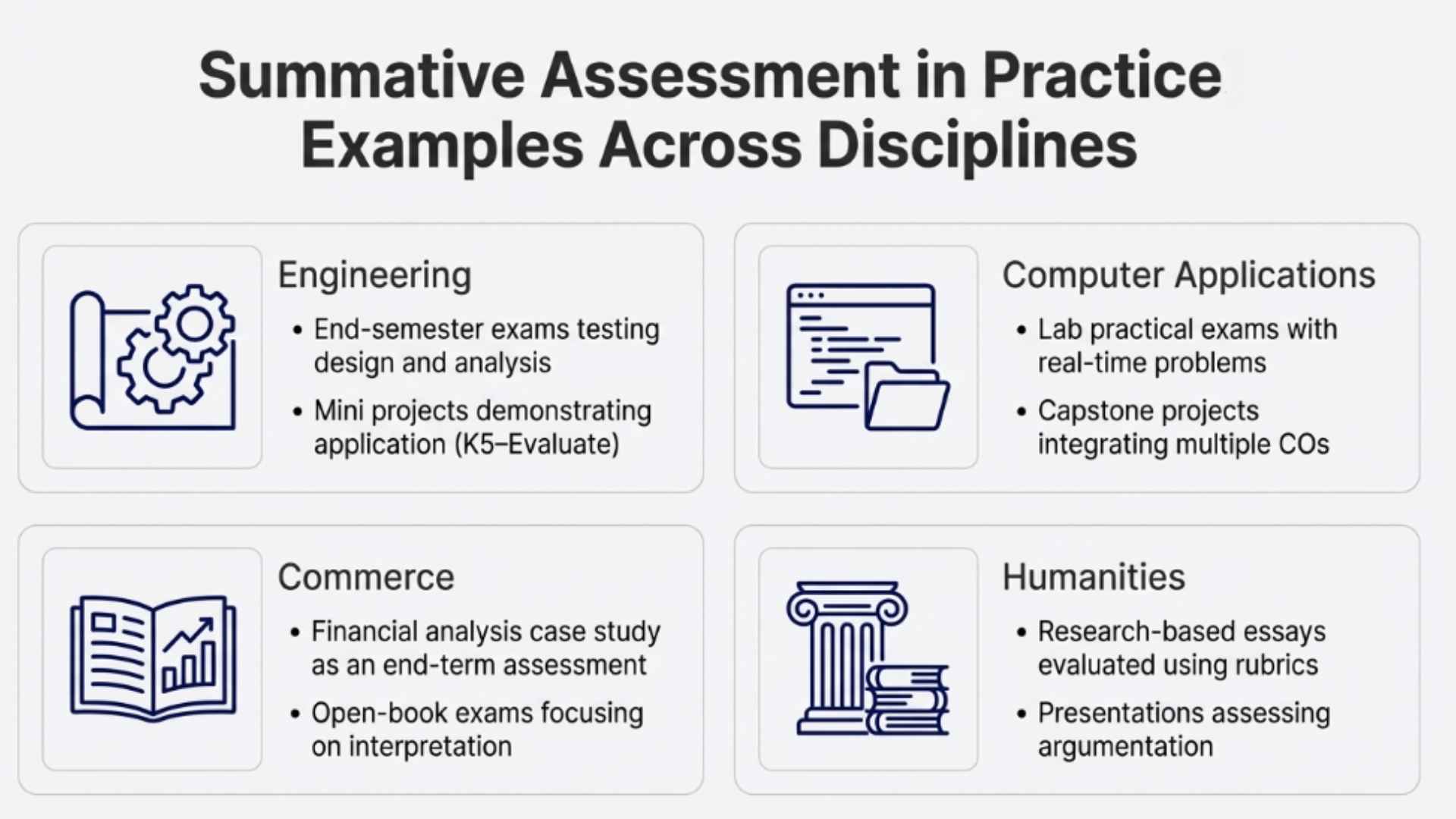 Engineering
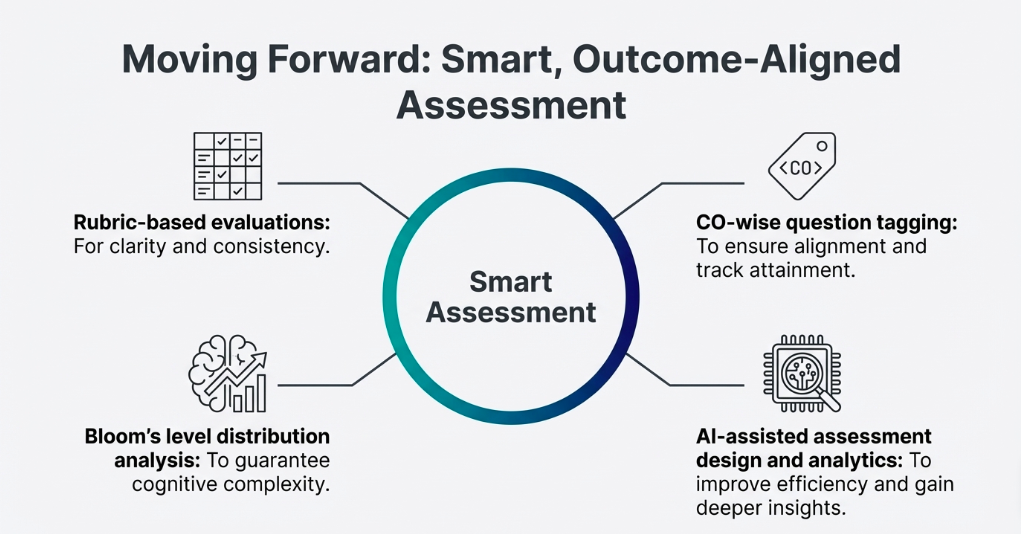 Yet, the philosophy remains traditional and timeless: Teach with care. Assess with clarity. Improve with evidence. When formative and summative assessments work together, education shifts from marks-driven to meaning-driven. And that’s where real outcomes happen. Author’s Note This article is grounded in practical OBE implementation experience across higher education institutions, aligned with accreditation frameworks and contemporary assessment research, while respecting long-standing pedagogical principles. [/fusion_text][/fusion_builder_column][/fusion_builder_row][/fusion_builder_container]